The post Financial Times appeared first on Wolfgang Baier.
]]>
Singapore delivers a new post
Mail man: Wolfgang Baier brings family pedigree and experience at McKinsey to the postal business
“It can’t be an accident that I have the postal business in my blood,” says Mr Baier, who has been chief executive of Singapore Post since 2011.
View full story here: https://www.ft.com/content/146b5f74-4226-11e3-bb85-00144feabdc0?mhq5j=e3
The post Financial Times appeared first on Wolfgang Baier.
]]>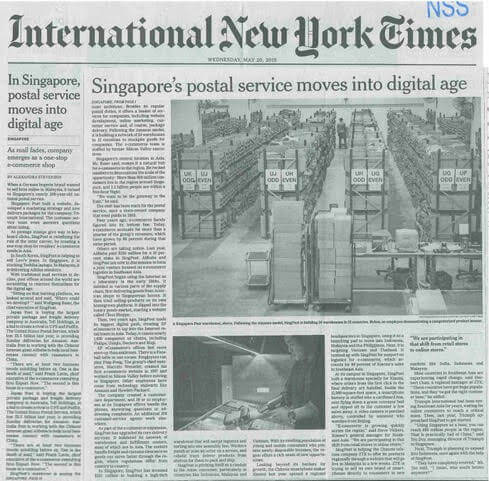
International New York Times – Singapore’s postal service moves to digital age
SINGAPORE — When a German lingerie brand wanted to sell bras online in Malaysia, it turned to Singapore’s nearly 200-year-old national postal service.
Singapore Post built a website, developed a marketing strategy and now delivers packages for the company, Triumph International. The customer service team even answers questions about sizing.
As postage stamps give way to keyboard clicks, SingPost is redefining the role of the letter carrier, by creating a one-stop shop for retailers’ e-commerce needs in Asia.
In South Korea, SingPost is helping to sell Levi’s jeans. In Singapore, it is stocking Toshiba laptops. In Malaysia, it is delivering Adidas sneakers.
With traditional mail services in decline, post offices around the world are scrambling to reinvent themselves for the digital age.
“Sitting on that burning platform, we looked around and said, ‘Where could we develop?’” said Wolfgang Baier, the chief executive of SingPost.
Japan Post is buying the largest private package and freight delivery company in Australia, Toll Holdings, in a bid to create a rival to UPS and FedEx. The United States Postal Service, which lost $5.5 billion last year, is providing Sunday deliveries for Amazon. Australia Post is working with the Chinese Internet giant Alibaba to help local businesses connect with consumers in China.
“There are at least two business trends unfolding before us. One is the death of mail,” said Frank Lavin, chief executive of the e-commerce consultancy Export Now. “The second is this boom in e-commerce.”
SingPost’s makeover is among the most ambitious. Besides its regular postal duties, it offers a basket of services for companies, including website development, online marketing, customer service and, of course, package delivery. Following the Amazon model, it is building a network of 24 warehouses in 12 countries to stockpile goods for companies. The e-commerce team is staffed with former Silicon Valley executives.
An employee of SP eCommerce, started by Singapore Post two years ago, uses a computerized product locater that reduces the time needed to find and ship a consumer’s order. Credit Edwin Koo for The New York Times
Singapore’s central location, said Mr. Baier, makes it a natural hub for e-commerce in Asia. He recited numbers to demonstrate the scale of the opportunity: Over 600 million consumers live in the region around Singapore, and 2.2 billion people are within a five-hour flight.
“We want to be the gateway to the East,” he said.
The shift has been stark for the postal service, once a state-owned company that went public in 2003.
Four years ago, e-commerce barely figured into its bottom line. Today, it accounts for more than a quarter of the group’s revenues, which have grown by 60 percent during that same period.
Others are taking notice. Last year, Alibaba paid $250 million for a 10 percent stake in SingPost. Alibaba and SingPost are now in discussions to form a joint venture focused on e-commerce logistics in Southeast Asia.
SingPost began using the Internet as a laboratory in the early 2000s. It dabbled in various parts of the supply chain, first delivering goods from American shops to Singaporean homes. It then tried selling products on its own homegrown platform. It even dipped into the luxury goods market, starting a website called Clout Shoppe.
Then, two years ago, SingPost made its biggest digital push, creating SP eCommerce to tap into the Internet retail boom in Asia. Today, it counts nearly 1,000 companies as clients, including Philips, Uniqlo, Deckers and Muji.
SP eCommerce’s offices feel more start-up than mailroom. There is a Foosball table in one corner. Employees can play Ping-Pong. The group’s chief executive, Marcelo Wesseler, created his first e-commerce website in 1997 and worked in Silicon Valley before moving to Singapore. Other employees have come from technology stalwarts like Amazon and Hewlett-Packard.
The company also created a customer-care department. At its Singapore offices, 30 or so employees handle the phones, answering questions or addressing complaints. An additional 200 customer-service agents work elsewhere.
As part of the e-commerce expansion, SingPost upgraded its core delivery services. It has bolstered its network of warehouses and fulfillment centers, most of which are in Asia. The centers handle freight and customs clearance so goods can move faster through the region, where regulations differ from country to country.
The offices of SP eCommerce, which already has 1,000 clients whose products it helps sell online across Asia and Australia. Credit Edwin Koo for The New York Times
In Singapore, SingPost has invested $182 million in building a high-tech warehouse that will merge logistics and sorting into one assembly line. Workers punch or scan an order on a screen, and robotic trays deliver products from shelves for them to pack and ship.
SingPost is pitching itself as a conduit to the Asian consumer, particularly in countries like Indonesia, Vietnam and Malaysia. With its swelling population of young and mobile consumers with newly disposable incomes, the region offers a rich seam of new opportunities.
Looking beyond its borders for growth, the Chinese smartphone maker Xiaomi last year opened a regional headquarters in Singapore, using it as a launching pad to move into Malaysia, the Philippines and Indonesia. Next, it is targeting Vietnam and Thailand. It teamed up with SingPost for support on logistics for e-commerce, which accounts for 80 percent of Xiaomi’s sales in Southeast Asia.
At its campus in Singapore, SingPost built a warehouse specially for Xiaomi, where orders from the first click to the final delivery are handled. Inside the 11,000-square-foot space, a smartphone battery is stuffed into a cardboard box, sent flying down a green conveyor belt and zipped off to the customer a few miles away. A video camera is perched above, controlled by someone who watches from Beijing.
“E-commerce is growing quickly across the region,” said Steve Vickers, Xiaomi’s general manager for Southeast Asia. “We are participating in that shift from retail stores to online stores.”
SingPost is helping the Chinese telecom company ZTE to offer its products regionally through a website that will go live in Malaysia in a few weeks. ZTE is trying to sell its own brand of smartphones directly to consumers in new markets like Malaysia, Indonesia and India.
Most countries in Southeast Asia are experiencing rapid change, said Herbert Chan, a regional manager at ZTE. “These countries have got huge populations and they’ve got the right customer base,” he added.
Triumph International had been eyeing Southeast Asia for years, waiting for online consumers to reach a critical mass. Then, last year, Triumph approached SingPost to get started.
“Using Singapore as a base, you can reach 680 million people in the region. That is practically half of China,” said Teo Doy, managing director of Triumph in Singapore.
Next, Triumph is planning to expand into Indonesia, once again with the help of SingPost.
“They have completely evolved,” Ms. Teo said. “I mean, who sends letters anymore?”
SOURCE: https://www.nytimes.com/2015/05/19/business/international/singpost-reinvents-for-digital-age-of-ecommerce.html
The post International New York Times appeared first on Wolfgang Baier.
]]>The post The Business Times appeared first on Wolfgang Baier.
]]>
“The biggest danger is that we become complacent. We want a company that is 150 years old to last another 150 years,” says Dr Baier.
Leading SingPost’s e-commerce charge
WOLFGANG Baier, 41, is a whirlwind of energy as he explains how e-commerce is going to change the world. More and more people will be buying fashion, high-tech products and even furniture and car wheel rims online, says the chief executive officer of SingPost.
“It’s going to change the way we human beings live and do things. You can see the patterns in US and Europe, and South-east Asia is leapfrogging because of smartphones and infrastructure,” he says excitedly.
“I see people shopping much less and doing other things in their free time. The e-commerce push is not something that we gradually grow. I think it’s going to be exponential.”
A former partner at consultancy McKinsey, Dr Baier has worked with some of the biggest logistics and postal players in the world. Now, he is spearheading SingPost’s transformation from stodgy mailman to a South-east Asian tech and logistics giant.
He has a habit of speaking quickly and enthusiastically. “I’m either highly charged or completely lazy – I don’t have grey areas. When I go home, the energy drops,” he tells The Business Times.
Since joining SingPost in 2011 to oversee the growth in non-mail products, Dr Baier – whose mother and grandfather both worked in postal services – has pushed the company into every area imaginable in the e-commerce value chain. Subsidiary SingPost eCommerce now provides more than 1,000 companies with services such as setting up an e-commerce website, sorting out goods at warehouses, organising shipments, sorting out customs clearances, and even providing call centre support. This is up from fewer than 100 customers four years ago.
Notably, SingPost attracted the attention of Chinese Internet giant Alibaba last year.
Alibaba was looking for logistics and warehousing services in the region for goods it needed to deliver to customers. Within months of testing out SingPost’s services, Alibaba bought a 10.35 per cent stake in SingPost for S$312.5 million in May 2014. Both parties also signed an agreement to pursue a joint venture in the business of e-commerce logistics.
“Early last year they were here as a customer. After a while, they said: ‘Hey guys, how good are you really in the region?’ We gave them the keys and said: ‘Why don’t you check for yourself?’ They came back and said: ‘You guys have something’,” Dr Baier recalls.
“We had set up a name for ourselves; people see that we’re transforming.”
The collaboration is now bearing fruit in Singapore and Indonesia, with other countries in the pipeline, he says.
Dr Baier is also trying to change the company culture by putting new values in place and encouraging a startup, risk-taking mentality among staff. Among other things, he worked at creating a sense of urgency in the company’s 7,000 employees worldwide, inculcating a new vision of transformation. Values like teamwork, trust, top execution and prioritising the customer were emphasised.
“We worked on what platform we’re building that we can jump into, otherwise we’ll be grilled alive. Then we set the very new values in place,” he says. “We said business as usual cannot exist here. If you do anything based on the past, in a fast-changing economy, you’re most likely wrong.”
His challenge is to keep the momentum of transformation going, he says. “The biggest danger is that we become complacent. We want a company that is 150 years old to last another 150 years.”
One aspect of e-commerce, according to Dr Baier, is that it is a “local game”. This means customers prefer buying from a website that understands their preferences.
“You need to have everything localised, from bank cards to currency to the way you market. In Singapore, you market football; in the Philippines, you market basketball,” Dr Baier says. “You need a local store, you need to speak their language.”
For example, SingPost has designed e-commerce websites in various countries for German sports brand Adidas, the first company to sign up in December 2012 to SingPost’s full e-commerce offering. Adidas’ India website has a section on cricket apparel. The Malaysian website allows online payment by CIMB and Maybank customers.
Other than Adidas, 14 other customers are tapping SingPost to manage their entire e-commerce value chain, including a popular American jeans brand, German lingerie maker Triumph, Japanese household goods store Muji, and electronics makers Toshiba and Philips.
The rest of SingPost’s e-commerce customers sign on to specific types of services. Recently, the company was approached to manage an Asian call centre for a European luxury goods company, Dr Baier says.
The call centres that SingPost sets up provide services beyond the basic such as answering queries on where one’s parcel is or how much a product costs. Rather, they are equipped to answer higher-level queries such as “I saw this bag on the website, is it dark brown or yellow?”, he points out.
Thus SingPost’s role in e-commerce goes beyond fulfilment – a term used to describe the storage of e-commerce goods, picking specific goods to meet an order, and packaging and sealing each order.
Rather, Dr Baier says, there is the web store, the delivery and returns process, and international freight forwarding, which is ensuring that goods from a manufacturer are shipped around the world to their required destinations or distribution centres, while clearing various customs processes.
“We pioneered it four to five years ago . . . When we first came in, there was no one around, that’s why we were able to expand very fast,” he says.
In this logistics chain, the front-end capabilities to build web stores cannot be neglected because competitors can always jump in with cheaper offerings for SingPost’s business customers.
“We cannot afford to be disintermediated,” he says.
Dr Wolfgang Baier joined SingPost in February 2011 as chief executive officer of its international business, looking at ways to grow the company’s non-mail products, such as logistics, retail and e-commerce, and accelerate the group’s regional expansion. In October 2011, he was appointed group CEO.
“I knew SingPost quite well and was already advising it, so I had a head start. The chairman and the board had been pushing for e-commerce for many years,” says Dr Baier, who was with McKinsey Singapore from 2004 to 2011 and holds a PhD in Law from the University of Vienna along with Master degrees in law and business economics.
At McKinsey, he led its postal and logistics practice as well as operations activities in South-east Asia.
He had wanted to return to the region ever since he first came with his parents to Asia in the 1980s and fell in love with the food, sights and smells here, he says.
Singapore plays a key role in regional e-commerce, he notes.
“It was one of the reasons why I joined SingPost. I saw a raw diamond, if you cut it right,” Dr Baier says. “Singapore has a very educated workforce, super digital capabilities, and agencies working with the government to set up an ecosystem.”
The country is thus poised to become an e-commerce hub in Southeast Asia, he says. If not for that, the company would not have invested S$180 million last year in an e-commerce logistics hub in Tampines, with many times current capacity, he notes.
“When we have conversations with (businesses) in Europe and the US, and we say Singapore, there’s trust,” he adds.
Typically, higher-value goods will be processed here such as luxury goods, fashion apparel and high-tech products, Dr Baier says.
Looking ahead, SingPost will continue to see falling margins in its traditional mail delivery business, he says.
The company used to enjoy mail operating margins of around 40 per cent, but mail volumes have been slipping even as fixed costs rise due to Singapore’s tight labour market. Mail segment operating margins are now around 30 per cent. “Postmen need to go to every house every day whether they carry 10 letters or two,” he says.
The e-commerce and logistics business, meanwhile, has far lower operating profit margins: 4.6 per cent for logistics and 10.6 per cent for retail and e-commerce as of SingPost’s most recent financial year. “So you need to grow fast,” Dr Baier says.
To compete in the e-commerce logistics space, SingPost will place itself between the big international players and the “mom and pop” local shops, he says.
What helps, he adds, is that SingPost’s cloud technologies and tracking and tracing systems are current, given that the company started from scratch only four to five years ago.
The company is also investing in delivery technologies. For example, deliverymen used to rely on industry- made handheld devices, which took a long time to upgrade. “We took it out and wrote software that runs on any mobile phone. There were huge cost savings. The software, picture taking are already integrated. We now have the ability to scale up very fast,” he says.
Another investment was in POPStations, which are 24-hour automated kiosks where consumers can pick up what they had ordered online.
After an order is completed with a retailer that SingPost has tied up with, such as Zalora, Rakuten or Alibaba’s Taobao, consumers get an SMS and e-mail when their parcel has been delivered to their local POPStation telling them they can collect the item at any time. There are now more than 100 such stations around Singapore.
The future of consumer goods delivery is through these automated stations, along with traditional routes such as to one’s door or to retail outlets, Dr Baier says.
More and more types of consumer goods, meanwhile, will be purchased online. SingPost recently launched sea freight capabilities for its vPost online shopping portal to give consumers a cheaper option to buy bulky items without paying expensive air freight rates.
“You can buy mattresses, furniture, even car rims,” Dr Baier says.
“South-east Asia parcel volumes are 20 per cent of what they are in developed markets. When you see that trend . . . that growth, we want to be part of that. We see ourselves as an enabler, a catalyst for that growth.”
E-commerce revenue now forms 28 per cent of SingPost’s overall revenues. Total revenue was S$920 million in SingPost’s last financial year, while underlying net profit was around S$157 million.
However, with most of its profits still coming from its traditional mail business, the company will continue to invest there, Dr Baier says.
Notably, it invested S$60 million to upgrade its traditional mail business, including converting the mailman’s traditional two-wheeler scooter into a three-wheeler version that can carry more and heavier e-commerce items while giving more stability and safety. Meanwhile, as machines take over mail sorting, most people have been redeployed to warehouse work, he says.
Ultimately, Dr Baier sees SingPost’s role in the e-commerce world as providing technology solutions, logistics services and e-commerce know-how for businesses aiming to go online to sell to their customers. In the jargon, it is a B2B4C approach.
SingPost will remain relatively asset-light while making investments in e-commerce logistics and mail infrastructure, he says. It already has a site called Omigo to sell goods made by some brands but the company does not plan to run large e-commerce, multi-brand platforms like Alibaba or eBay. “We see Omigo more as an extension of our enabling e-commerce ecosystem,” Dr Baier says.
The biggest risk the company took was the strong belief that a postal player can transform into an e-commerce firm, he says. “It’s not obvious. Five years later, people say, ‘Of course’. But when we were starting, people said, ‘Yeah, right’.”
SOURCE: http://www.businesstimes.com.sg/hub/singapore-corporate-awards-2015/leading-singposts-e-commerce-charge
The post The Business Times appeared first on Wolfgang Baier.
]]>